
Every founders starts a company with a suitcase full of dreams. But as they start working on it, they realize there is another suitcase that comes with starting a business.
A suitcase full of problems.
You open both at a same time and everything spills on the floor.
You need to move and build fast, you have to keep the cost low, you have to motivate the team, you have to manage investors.
So much for a single person or a team to do.
And this is where the tools become a necessity. Right tools will help you survive the startup chaos and deliver real world impact with your product or services.
And in this one we are going to discuss some of the must have tools for early stage startups.
But before that lets start with the common challenges.
Challenges of early-Stage startups
When someone starts a company, they think the first problem will be customers. But soon you realize that customers are just the part of the much bigger equation. There are many other challenges too.
Budget
Whether funded or bootstrapped, every founder faces the budget challenge. It never seems to be enough. Every decision will impact your finances. And you need tools to keep things going and they cost you money. You may try some free tools but they come with limits and you eventually have to pay as you scale. So, your burn shoots up without even seeing real impact.
Context switching
Many founders miss this, the context switching is silent productivity killer. Every time you and your team switches the tab or app, they lose focus and this focus cost you in terms of productivity.
Clarity
Everyone seems to be doing something but nobody is able to see the full picture. One team members makes a file, another shares a link and a third person updates that file without telling anyone. So much chaos. In this, work slows down.
Speed
Today, startups survive only when they move faster. You have to keep up with the customer expectations while keeping a close eye on competitors. Slow execution can result in loss of revenue and customer trust, so speed becomes much important than anything.
Workflow overload
Everyone at startup is wearing multiple hats. And you need the right tools that helps you get organized and actually gives you the real picture of what is happening. Without the right one, workflow keeps overloading without you delivering any real impact.
This is where the right stack changes everything.
Now, lets discuss the must have tools that everything startup should have to run smoothly and grow fast.
Must have tools for early stage startups
1. WhitePanther
Category: All in one productivity, collaboration and Communication Software
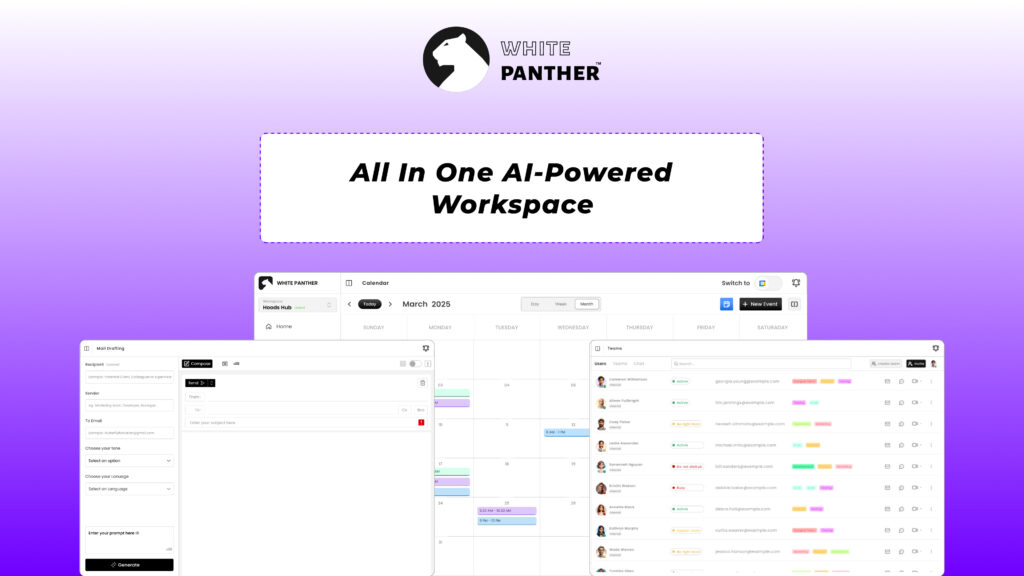
WhitePanther is the single dashboard you wish you had on day one. It gives you email, storage, tasks, meetings, communication, time tracking, screen recording, AI content tools, and more in one place. No reloads. No tab switching.
It is designed for freelancers, startups, SMEs, agencies, and remote teams that need everything in one clean space.
Key features
- Unified dashboard for tasks, communication, storage, and emails.
- Fast workflow with no reload and no constant switching.
- Cloud storage with Google Drive and Dropbox integrations
- AI drafting for emails, content, and documents.
- Calendar integration and scheduling.
- Time tracking, screen recording, and meeting tools built in.
- Smooth navigation with a floating module that follows your workflow.
Why it is best for early stage startups?
You save the money you would spend on ten tools.
You save the time you would waste switching between tabs.
You get clarity because every activity lives inside a single workspace.
You move faster because everything is right in front of you. WhitePanther becomes your daily home base where your team works without clutter.
2. Notion
Category: Knowledge management and documentation
Notion allows your startup to create documents, wikis, internal guides, roadmaps, and planning spaces. It becomes your second brain where all your information lives.
Key features
- Templates for docs, planning pages, databases, and tracking.
- Real time collaboration.
- Simple structure for organizing content.
- Easy sharing for team members or external partners.
Why it is best for early stage startups?
Your team will forget things if you do not document them. Notion becomes the place where everything stays. It helps you create clarity and structure without effort.
3. Slack
Category: Team communication
Slack is a simple communication tool that keeps conversations organized in channels. It replaces scattered messages and gives you space for real time collaboration.
Key features
- Channels for team discussions.
- Direct messages for quick chats.
- File sharing and integrations.
- Searchable history for projects.
Why it is best for early stage startups
You save hours every week by keeping all communication in one clean space. Your team stops losing messages. Everyone stays aligned.
4. Canva
Category: Design and branding
Canva helps you create presentations, branding assets, pitch decks, social posts, product visuals, and marketing content without needing a full design team.
Key features
- Thousands of ready to use templates.
- Drag and drop editor.
- Brand kit for fonts and colors.
- Team collaboration and shared folders.
Why it is best for early stage startups?
Your brand needs content every day. Canva helps you look polished even when you do not have a designer. It saves money and keeps you consistent.
5. Stripe
Category: Payments and subscriptions
Stripe helps you collect payments, manage subscriptions, automate billing, send invoices, and track revenue in real time.
Key features
- Simple integration with websites and apps.
- Subscription billing and recurring payments.
- Fraud protection.
- Dashboard for analytics and payouts.
Why it is best for early stage startups?
Payments should never be complicated. Stripe makes it easy to charge customers from day one so you focus on building the product.
6. HubSpot CRM
Category: Customer relationship management
HubSpot CRM gives early stage teams a simple way to track leads, follow up with customers, manage pipelines, and understand sales performance.
Key features
- Lead tracking and contact management.
- Email sequences and templates.
- Pipeline dashboard.
- Basic automation.
Why it is best for early stage startups?
You cannot afford to lose leads or forget follow ups. HubSpot keeps your sales process organized from day one.
7. Google Workspace
Category: Productivity and collaboration
Google Workspace gives you email, documents, sheets, meetings, and shared drives. It is the simplest tool set for daily operations.
Key features
- Gmail for communication.
- Drive for storage.
- Docs and Sheets for collaboration.
- Meet for quick calls.
Why it is best for early stage startups
It gives you the basics you need every day. You work fast. You share fast. You operate without friction.
Conclusion
Every startup begins with limited time, limited money, and unlimited dreams. The right tools help you protect your time and budget. They help you stay organized while you grow. They help your team move with clarity.
WhitePanther becomes your main workspace. Everything else supports it. You do not need a complicated stack. You just need a simple setup that lets you work, build, communicate, and create without slowing down.
If you choose the right tools early, you build a strong foundation. Your team works better. Your workflow becomes smoother. Your startup moves forward with confidence.
FAQs
1. What tools should an early stage startup focus on first?
Start with tools that reduce chaos. You need one workspace for tasks, emails, meetings, and communication. A tool like WhitePanther solves this from day one. Then add payment, CRM, design, and documentation tools.
2. How can startups save money on software in the early stage?
Use multi purpose tools instead of paying for ten separate subscriptions. Prioritize platforms that combine communication, storage, tasks, and emails in one place. This reduces burn and keeps your workflow simple.
3. Why is an all in one dashboard helpful for small teams?
Small teams lose time switching between apps. An all in one dashboard keeps everything in front of you. It gives you speed, clarity, and a smoother workflow. Your team works without distractions or confusion.
4. Do early stage startups really need a CRM?
Yes. Tracking leads with notes or spreadsheets causes missed follow ups. A simple CRM keeps your pipeline clean. It helps you stay consistent with customers and improves your chances of closing deals.
5. How do I know which tools are essential and which ones can wait?
Focus on tools that help you operate daily. If a tool improves communication, reduces switching, manages customers, or helps you collect payments, it is essential. Everything else can wait until your team grows and your workflow becomes more complex.

SEO Content Marketer
I help IT, SaaS, and tech brands turn complex ideas into clear, conversion-focused content—blogs, landing pages, and campaigns that educate buyers, build trust, and drive qualified leads. I blend sharp storytelling with SEO and marketing strategy so every piece earns its place in the funnel.