
TL;DR
- Async communication lets people reply on their own time
- It reduces interruptions and protects deep work
- Async teams avoid unnecessary meetings and move faster
- Clear updates and documentation make collaboration smoother
- Screen recordings and organized threads strengthen async workflows
- Tools like WhitePanther help keep everything connected in one place
Async communication is one of those concepts everyone pretends to understand, but the moment you ask them to define it, they look like someone unplugged their brain. And honestly, that’s why most teams struggle. They think async communication is just “sending a message instead of calling,” but the whole idea goes way deeper.
In this article, we are going to break it down in a way that makes sense for real-world async teams, not the theoretical ones in fancy productivity books.
What Is Async Communication?
Think of Asynchronous communication as the opposite of “Hey, got a minute?” culture. It’s communication that doesn’t require an instant reply. When someone in your async team shares an update, they’re not expecting you to drop everything and respond right away. You answer when you’re available, and the work keeps flowing without constant interruption.
Asynchronous communication usually happens through tools that allow:
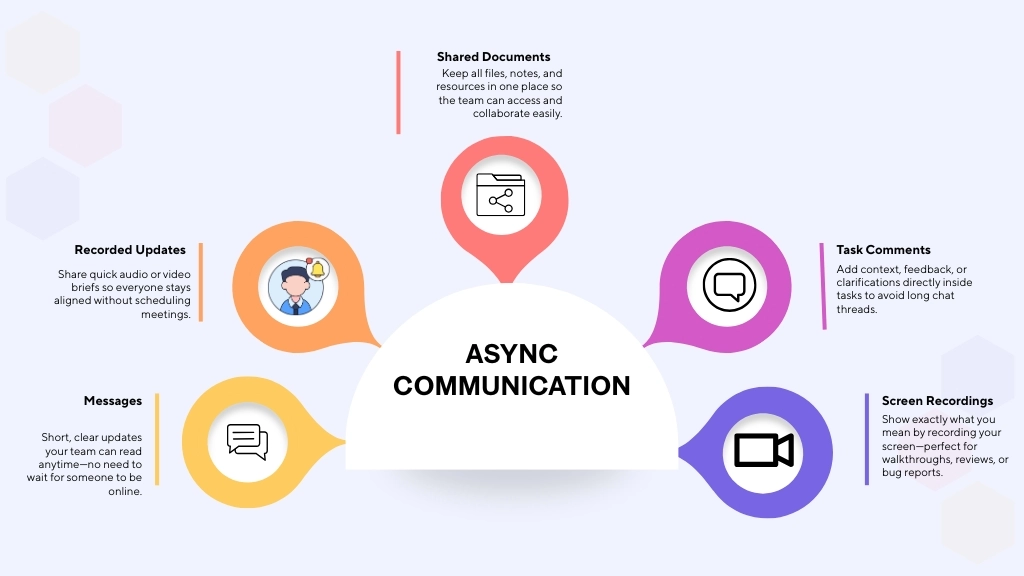
It’s communication without the pressure of being “always on,” which is basically the dream scenario for anyone who has ever sat through a pointless meeting that could’ve been a message.
Also Read : https://www.linkedin.com/pulse/tips-balancing-synchronous-asynchronous-work-whitepanther-rq4pc
Why Async Communication Is the Backbone of Modern Collaboration
Modern work has changed. We all know it. Teams aren’t sitting in the same building anymore. Time zones aren’t synced. Focus time is rare. And attention spans? Let’s not even talk about that. This is exactly where async communication becomes the backbone, not just a convenience.
Let’s break down why.
1. Async Communication Reduces Panic-Driven Work
When teams rely too much on real-time chats, everything becomes urgent by default.
You’ve seen it:
Someone asks a question. You reply late. They think you’re ignoring them. Then the meeting invite lands.
Async communication removes that needless stress. People reply thoughtfully, not reactively. Async teams work like adults, not crisis firefighters.
2. Async Communication Protects Deep Work
Every time someone pings you with “quick update,” your brain derails for 20 minutes. Multiply that by a day and your productivity is toast. Async communication gives you breathing room. You can batch messages, reply at your pace, and keep your brain in one place instead of bouncing between ten half-finished tasks.
3. Async Teams Move Faster by Avoiding Unnecessary Meetings
Half the meetings you attend could be a well-written message or a screen recording. Async communication makes that shift possible. Async teams don’t need to “sync” for every tiny detail. They follow documented updates instead of 10 people joining a Zoom call only for three of them to talk. Meetings become meaningful instead of mandatory.
4. Async Communication Levels the Playing Field for Everyone
Not everyone thinks quickly on the spot. Not everyone loves talking on calls. Async communication gives thinkers, introverts, and people who like structure a chance to respond with clarity Async teams end up making better decisions because the quality of communication rises.
5. Async Teams Scale Without Chaos
When your team grows, real-time communication becomes a nightmare.
More pings. More distractions. More people fighting for attention.
Async communication allows scaling because:
- updates are documented
- conversations stay searchable
- decisions don’t vanish after a call
- onboarding becomes easier because everything has a trail
It turns the daily workflow into a system, not a mess.
Why Async Communication Works So Well for Modern Async Teams
Even traditional companies are waking up to a simple truth: synchronous communication is tiring, distracting, and often unnecessary. Modern async teams prefer async communication because it:
- supports global collaboration
- removes time zone pressure
- encourages written clarity
- reduces decision fatigue
- improves transparency for new team members
- gives everyone room to think before responding
Instead of living inside never-ending calls, async teams build a rhythm where work flows without constant interruptions.
People don’t sit waiting for replies. They start tasks, update them, move forward. In other words, async communication builds momentum, something synchronous teams lose easily.
Tips to Use Async Communication Better
Using async communication is not just about sending delayed messages. It’s about communicating in a way that removes chaos and keeps your async team aligned even when everyone’s working at different times. Here’s how to actually make it work in real life.
Be clear, not cryptic.
Async communication falls apart when messages are vague. If someone has to guess what you mean, you’re not being async, you’re creating more work. Spell out what needs to be done, why you need it, and what “done” looks like. A little context upfront saves hours of back-and-forth for the entire async team.
Use screen recordings when text feels too long.
Some explanations don’t belong in paragraphs. A quick walkthrough makes everything easier. Tools like WhitePanther make this smooth because you can record your screen right inside the dashboard without opening extra apps or switching tabs. Instead of dragging the whole async team into a meeting, you drop a recording, they watch it when free, and the work moves ahead.
Document decisions so nothing gets lost.
Async communication works only when updates stay accessible. When your async team makes a decision, note it where everyone can find it. WhitePanther helps here too because tasks, notes, files, and messages sit in the same workspace, so nobody has to hunt for “that one thing someone said in that one chat.”
Stop expecting instant replies.
If you need someone to respond right away, that’s synchronous work pretending to be async. Let people reply within a reasonable window. Async communication gives your async team the freedom to work without constant interruption, so don’t ruin it by hovering for replies.
Use structured threads to avoid chaos.
Dumping everything into one chat thread is the fastest way to kill async communication. Keep topics organized. If a task has an update, post it where that task lives. If a project has questions, put them under the project. WhitePanther’s workspace structure helps keep conversations grouped naturally, which makes async work less messy.
Close the loop so everyone stays aligned.
Async communication isn’t finished when you send a message. It’s complete when the loop closes. When you finish a task, update the thread. When a decision is final, mark it clearly. When someone gives input, acknowledge it. Async teams function smoothly only when everyone knows the status without chasing it.
Conclusion
Async communication isn’t just a trend, it’s the foundation of how modern async teams actually get real work done. It removes pressure, protects focus, and helps teams grow without drowning in calls and chaos.
Whether your team is fully remote, hybrid, or global, async communication lets you work smarter instead of faster. It gives people space to think, prioritise, and contribute without the noise of constant interruptions.
The best part? Async teams feel calmer, more organized, and more in control of their workday.
And once a team experiences that level of clarity and freedom, they never want to go back to the old way.
FAQs
1. What is async communication?
Async communication is a way of working where messages don’t require instant replies. People respond when they’re available, which helps reduce interruptions and keeps work flowing smoothly.
2. Why is async communication important for modern teams?
It protects deep work, reduces unnecessary meetings, improves clarity, and makes collaboration easier across different time zones. Async teams move faster because updates don’t depend on everyone being online at the same time.
3. How does async communication reduce meetings?
Many discussions can be handled through written updates or screen recordings instead of live calls. Once teams adopt async habits, only essential topics turn into meetings, which saves time.
4. How can WhitePanther support async communication?
WhitePanther brings tasks, updates, screen recordings, files, and messages into one dashboard with no tab switching. This central hub makes async teamwork easier, especially when explaining work with screen recordings or tracking decisions.
5. What habits make async teams more effective?
Clear messages, proper documentation, structured threads, respecting response windows, and closing communication loops all help async teams stay aligned and productive.