
Let’s be honest, most startup emails look the same.
A catchy subject line, a button that says “Get Started,” and a paragraph trying to sound confident.
But here’s the truth: what works for enterprises doesn’t work for startups(most of the time).
Startups have a very difference audience and a story to tell. Your customers don’t know you yet.
So, copying the templates from big brands that already have trust and data won’t for the startup.
So, let’s talk about how email marketing for startups actually works.
What to include, what to skip, and how to write emails that feel personal, convert better, and grow with your users.
Table of Contents
Why Email Marketing Is Important for Startups
Email marketing is important for startups because it gives you direct, owned access to your users without relying on ads, algorithms, or third-party platforms.
For early-stage startups, email isn’t just a marketing channel—it’s a growth and learning loop.
The Reality of Email Marketing for Startups
Before we dive into frameworks and tools, here’s something that might sting a bit:
Your early emails aren’t about “sales.”
They’re about trust, story, and curiosity.
Large companies can afford to say, “Buy now, 30% off”, because people already know them.”
Startups can’t. Your readers don’t owe you their time yet.
That’s why email marketing for startups should focus less on “how can I sell?” and more on “how can I make people care?”
Think of it like this:
- Enterprises write from authority.
- Startups write for connection.
Once you make that shift, everything changes, your open rates, click rates, even your unsubscribe rates.
Framework: The 4C Formula for Startup Emails
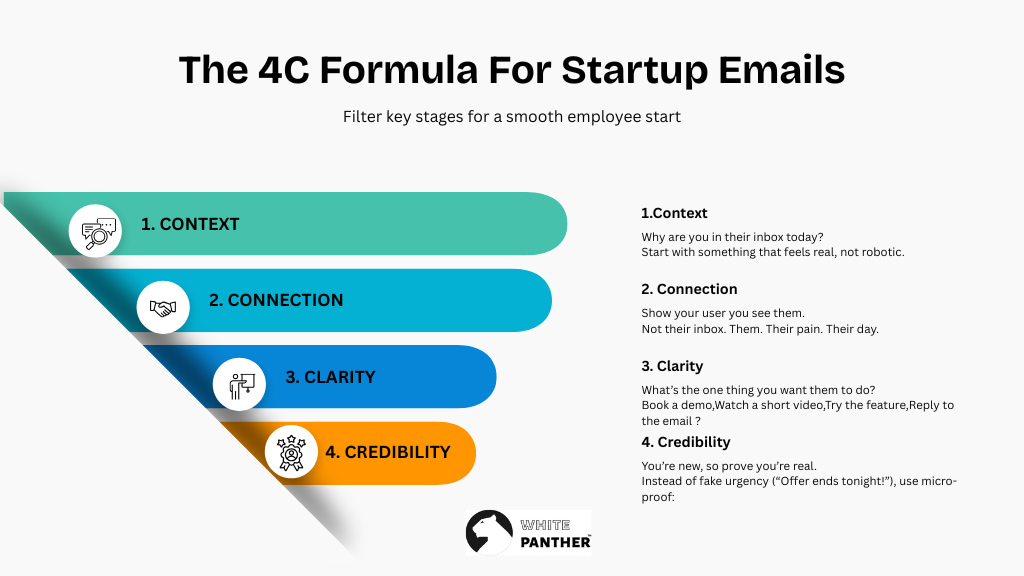
Here’s a simple framework to follow, we call it the 4C Formula.
It’s designed specifically for email marketing strategies for startups that don’t have large content teams or automation setups yet.
1. Context
Why are you in their inbox today?
Start with something that feels real, not robotic.
Example:
“We just wrapped our first 100 customer onboarding sessions this month, and one thing stood out, everyone struggled with XYZ. So we fixed it.”
This instantly feels human, grounded, and relevant.
2. Connection
Show your user you see them.
Not their inbox. Them. Their pain. Their day.
Example:
“You probably signed up because managing three dashboards is already a pain. We felt the same before building our own solution.”
That sentence builds empathy and makes your product part of their story.
3. Clarity
What’s the one thing you want them to do?
Only one.
- Book a demo
- Watch a short video
- Try the feature
- Reply to the email
If you give three CTAs, people will do none.
4. Credibility
You’re new, so prove you’re real.
Instead of fake urgency (“Offer ends tonight!”), use micro-proof:
- Short testimonials
- Screenshots of real user comments (UGC!)
- Personal milestones (“Our 500th signup today!”)
These details make you trustworthy, not loud.
What Startups Get Wrong with Email Marketing
Here’s where most email marketing for startups goes off-track:
- Copying enterprise tone – sounding too polished or corporate.
Instead, sound like a founder writing to a friend, not a PR person writing to a journalist.
- Ignoring user-generated content (UGC) – startups rarely leverage early supporters’ stories.
UGC builds relatability. Even a screenshot of a user tweet or testimonial adds authenticity.
- Sending the same email to everyone – your user who just signed up doesn’t need the same email as someone using your app for a month.
Use behavioral segmentation, even if it’s basic: “new signups,” “active users,” “churned users.”
- No narrative – startups forget to tell why they exist.
Every email is a chance to tell one small part of your bigger mission.
Writing Emails That Convert (Without Sounding Like a Brochure)
Here’s how you can instantly level up your email marketing strategies for startups:
A. Write like a person, not a pitch
Startups often try too hard to sound “professional.” But people crave authenticity.
Try this:
Instead of “We are thrilled to announce our latest feature rollout,”
say, “We’ve been building something we couldn’t wait to share.”
One feels corporate. The other feels like a conversation.
B. Use mini-stories in every email
Every startup has stories, building, failing, fixing.
Share them.
Even a 2-line story about what inspired a feature works better than generic copy.
Example:
“When we first tried managing tasks across 4 tabs, our laptops hated us. That’s when we built the no-tab switch view.”
See? That’s not a pitch. That’s personality.
C. Give something before asking
Before saying “Book a demo,” offer value.
Examples:
- A short checklist (like “5 things that kill your productivity”)
- A free template
- An insight from your internal data
Giving builds goodwill.
Goodwill builds conversions.
D. Use visuals and UGC smartly
Don’t waste your hero banner with a generic stock image.
Show your product in real use.
Better yet, show users.
- Real screenshots from Slack or social media
- Short feedback from your first 50 users
- Photos of your small team at work
These human cues remind readers there’s a real startup behind the email, not a faceless company.
E. Make your CTA conversational
Instead of “Get Started”, try:
- “See how it feels”
- “Try it in 2 minutes”
- “Let’s do this together”
A small copy shift can make your click rate jump 20–30%.
F. The Missing Ingredient: Two-Way Conversations
Most startups treat email as a one-way street, they talk at users, not with them.
That’s where enterprises win. They listen.
Here’s how to fix that:
- Ask questions: “What’s one thing you’d want us to fix first?”
- Add a simple reply CTA: “Just hit reply and tell us.”
- Use replies as data: Feed responses into your CRM or Notion to inform future campaigns.
This builds a community, not just a list.
When someone replies, they move from “subscriber” to “supporter.”
That’s the most powerful form of conversion.
Proven Email Marketing Strategies for Startups (That Don’t Require Big Budgets)
These are practical, low-cost strategies startups can implement today:
1. Onboarding drip with emotion, not instruction
Most onboarding emails are too technical.
Instead of saying: “Set up your profile,”
say: “You’re just one step away from saving your first project.”
2. The 2-week user check-in
After two weeks, send a personalized check-in.
Example:
“Hey [Name], we noticed you’ve used our task tracker 7 times already! How’s it going?”
Use merge tags and user behavior data from your product or CRM.
3. The founder’s personal note
Send a plain-text email directly from the founder’s email.
Keep it short and real.
“We started [product] to solve a problem that used to frustrate us daily. How are you finding it so far?”
These get up to 3x higher reply rates than fancy newsletters.
4. The “We listened” update
Show you’re building with feedback.
“You asked for a dark mode. We delivered. Here’s how it looks.”
This shows momentum, responsiveness, and care.
What Performance Should Startups Expect?
While every audience is different, early-stage startups often see:
– Founder emails with 2–3x higher reply rates
– Plain-text emails outperforming designed emails by 15–30%
– Follow-up emails performing better than the first send
For startups, replies and conversations matter more than raw click-through rates.
Email Marketing Tools for Startups (Quick Comparison)
Choosing the right email marketing tool depends on your startup stage, team size, and how closely email is tied to your product.
Early-stage startups usually need tools that are:
- Easy to set up
- Affordable as they grow
- Flexible enough to support onboarding, updates, and feedback emails
Below is a quick comparison of popular email marketing tools used by startups today.
| Tool | Best For | Limitation |
|---|---|---|
| WhitePanther | All-in-one startup operations | Newer brand |
| MailerLite | Simple campaigns | Limited product email depth |
| ConvertKit | Creator-led startups | Gets expensive at scale |
| Beehiiv | Content-first startups | Less product-focused |
| Mailchimp | Beginner-friendly marketing | Pricing increases quickly |
| Brevo (formerly Sendinblue) | Transactional + marketing emails | Interface can feel complex |
How to Choose the Right Tool as a Startup
- If you want email + internal tools in one place, an all-in-one platform like WhitePanther can reduce tool overload.
- If you’re sending basic newsletters or announcements, MailerLite is simple and beginner-friendly.
- If your startup is creator-driven or audience-led, ConvertKit offers strong audience segmentation—but costs can grow quickly.
- If email is mainly for content distribution, Beehiiv works well, though it’s less suited for product-led communication.
Key Takeaway for Startups
There’s no “best” email marketing tool—only the best fit for your stage.
For early startups, prioritize:
- Simplicity over advanced automation
- Flexibility over feature overload
- Tools that support conversations, not just campaigns
As your startup grows, your email tools should grow with you—not slow you down.
Whitepanther to Power Email Marketing for Startups
You don’t need expensive tools to start. You just need WhitePanther.
If you’ve ever juggled between Gmail tabs, Mailchimp dashboards, and random spreadsheets just to send one email, you’ll understand why WhitePanther’s email marketing is the best email marketing tool for startups.
- You can segment your customers and target them with personalized emails.
- Built in AI to generate ready to send emails
- No contact limits like most email marketing tools have
Plus, WhitePanther offers other built in tools and integration to help you be more productive and collaborate better as a startup.
- Get built in chat, meetings, time tracker, project management, documents, screen recorder and AI
- Integrate with email, calendar, storage and payment tools.
- No per seat fee, so you can grow without increasing cost of tools.
Start your email marketing campaigns and get all the tools you need in one dashboard for a flat fee.
How to Approach Users (The Soft-Sell Way)
Startups shouldn’t push, they should invite.
Here’s the approach that works:
- Start with why you built this.
“We made this because managing 3 dashboards every day was exhausting.”
- Show what’s new or different.
“It’s like having Slack, Drive, and Tasks, all in one tab.
- Invite them to try, not buy.
“Try it free for a week, tell us what feels off.”
- Follow up with social proof.
“500 freelancers are already using it daily. Here’s what they said.”
- End with gratitude.
“Thanks for being part of our early journey. We’re building this with your feedback.”
This human-first communication is what sets email marketing for startups apart from big-brand newsletters.
Common Email Marketing Mistakes Startups Should Avoid
- Overloading features: Don’t explain everything. Explain one benefit per email.
- Long paragraphs: Keep your sentences short and visual.
- Design obsession: A clean plain-text email can perform better than a perfect HTML layout.
- No follow-ups: The second email often performs better than the first.
- Skipping testing: Even small startups should A/B test subject lines and CTAs.
Is Email Marketing Still Worth It for Startups in 2026?
Yes—email remains one of the highest ROI channels for startups because it gives you direct access to your users without relying on ads or algorithms.
For early-stage startups, email works best when used for:
- User education
- Feedback collection
- Relationship building
- Product iteration
The startups that win with email treat it as a conversation, not a broadcast.
Wrapping Up: The Startup Email Advantage
The best part about being a startup?
You’re still human-sized.
Your users don’t expect perfection, they expect honesty.
They want to see what you’re building, why you’re building it, and how it’s helping real people.
So stop trying to look like an enterprise.
Start writing like someone they can trust, follow, and root for.
Because great email marketing for startups isn’t about sending more emails,
It’s about sending better ones.
FAQs on Email Marketing for Startups
1. What makes email marketing important for startups?
For startups, emails helps them build direct relationships with the customers. It is not just about sharing updates, its more about building a loyal audience. Plus, it helps you convert early users without spending much on ads.
2. How can startups make their emails stand out?
The simple tip is to sound like a human and not machine. Most startups directly start promoting without building a connection. So, keep the emails short, personal and story driven.
3. What are some effective email marketing strategies for startups?
Always segment your audience based on preferences and use UGC and send based content before you start pitching your product.
4. How often should a startup send marketing emails?
Once or twice a week is ideal. It is enough to stay visible without spamming your subscribers.
5. What tools are best for email marketing for startups?
Tools like WhitePanther,MailerLite, ConvertKit, and Beehiiv are great for startups. They are affordable, and easy to automate your email marketing campaigns.